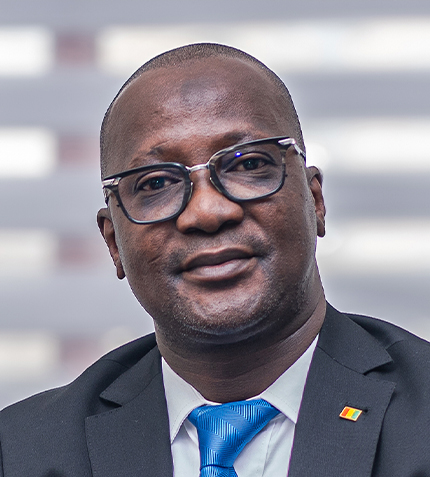
“Thanks to the quality of our resources and our operational controls, CBG has distinguished itself as one of the premier bauxite producers in the world.”
Share
What are your priorities as newly elected President of the Guinea Chamber of Mines?
The Guinea Chamber of Mines is a well-established institution of over six decades that represents more than 70 enterprises. Taking over the helm of the Chamber, my first priority is to continue what my predecessors started and ensure that the Chamber remains a preferred interlocutor for the government, public authorities, and centralized state bodies, especially during legislative changes in the mining sector. The Chamber is positioned as a reliable intermediary that can assist the government with the implementation of public policies in the sector. Another pillar of our work is to make sure that our members feel safe operating in Guinea. Thirdly, we are the custodian of CSR, as a non-negotiable criterion for all operators. We are in the process of reviewing our statutory documents to introduce a clearer and more defined framework aligned with international environmental, ethical, and responsibility standards.
Could you provide a brief introduction to Compagnie des Bauxites de Guinée (CBG), its role in the global bauxite sector, and the socio-economic impact of operations for the country?
CBG is the oldest mining company in Guinea, with a history dating back to 1963. We are also the only mining company in Guinea in which the state holds a 49% stake, with Halco Mining retaining the majority 51%. Halco is a joint venture between Alcoa, Rio Tinto, and Dadco. The Guinean government also receives 65% of revenues. This places CBG as a leading participant in the Guinean economy. The bauxite produced at our operations in Guinea is sold internationally to leading multinationals like Alcoa, Rio Tinto, Dadco, which then transform the raw material into alumina and subsequently aluminum, supplied into downstream value chains such as aeronautical and automotive manufacturing.
Thanks to the quality of our resources and our operational controls, CBG has distinguished itself as one of the premier bauxite producers in the world. ESG is closely integrated into our DNA, and we take great care of both our surrounding communities and our direct and indirect employees. Our leadership, shared between tier-one companies, holds us accountable to the highest standards. That differentiates us from other operators.
How is CBG responding to the government’s push for local refining?
We are looking to diversify our activities and invest in an alumina refinery to contribute to the development of the local value chain and also capture better margins for both our shareholders and our broader stakeholders, including the people of Guinea. Our vision is to participate in the development of Guinea, as we have done for over 50 years.
The Simandou US$20 billion investment is projected to turn Guinea into one of the fastest-growing economies. What has enabled the takeoff of this massive project at this time?
The WBG investment only reinforces Guinea as a prime destination for investment. The geological prospectivity of Guinea is so rich that some see the country as a geological reference; it would be difficult to find a place in Guinea where you would not find resources. Simandou, with its large scale in a relatively small country like Guinea, has greatly influenced the country’s fate. That this project is happening here shows the trust that its investors place in Guinea. Key to that is ensuring that the commitments made by all parties involved—the government on one side and investors on the other—are respected.
Several conditions had to be met to facilitate this flagship investment, going beyond geological richness, including the availability of a skilled workforce that may not have been present several years ago. Today, young people are attending specialized schools, including the Simandou Academy. On top of that, the country is making major strides to offer stability, favorable legislation, and an incentivizing fiscal framework, all of which inspire confidence.
What is your view on the recent revocations of mining licenses?
There’s a saying found in legislation around the world that says, “what the common will do, the common must respect and the common must undo,” which means that he who makes the rules must also respect and enforce them. In that sense, all parties must accept their obligations. As the mining sector began to experience a boom, we noticed that some operators were not meeting their commitments. The legislative and regulatory framework gives the administration the responsibility to monitor and ensure that investors are fulfilling their obligations. The recent revocation of mining licenses occurred precisely because the administration is respecting its own duty to enforce the law, and mining companies must do the same.
Do you have a final message?
At CBG, we put our employees at the center of our strategy. Mining companies nowadays are preoccupied with investing heavily in technology and equipment, forgetting about people. We place the greatest value on our human capital, which we believe to be key to our company’s longevity.
Another important focus for us is not just looking at what and how much we produce, but also how we produce. Too many bauxite producers in the world disregard local regulations, the environment, and even human rights, so for us it is crucial to set an example of responsible mining and leave the environment in an even better place than we found it, and our communities more prosperous than before mining.

What are your priorities as newly elected President of the Guinea Chamber of Mines?
The Guinea Chamber of Mines is a well-established institution of over six decades that represents more than 70 enterprises. Taking over the helm of the Chamber, my first priority is to continue what my predecessors started and ensure that the Chamber remains a preferred interlocutor for the government, public authorities, and centralized state bodies, especially during legislative changes in the mining sector. The Chamber is positioned as a reliable intermediary that can assist the government with the implementation of public policies in the sector. Another pillar of our work is to make sure that our members feel safe operating in Guinea. Thirdly, we are the custodian of CSR, as a non-negotiable criterion for all operators. We are in the process of reviewing our statutory documents to introduce a clearer and more defined framework aligned with international environmental, ethical, and responsibility standards.
Could you provide a brief introduction to Compagnie des Bauxites de Guinée (CBG), its role in the global bauxite sector, and the socio-economic impact of operations for the country?
CBG is the oldest mining company in Guinea, with a history dating back to 1963. We are also the only mining company in Guinea in which the state holds a 49% stake, with Halco Mining retaining the majority 51%. Halco is a joint venture between Alcoa, Rio Tinto, and Dadco. The Guinean government also receives 65% of revenues. This places CBG as a leading participant in the Guinean economy. The bauxite produced at our operations in Guinea is sold internationally to leading multinationals like Alcoa, Rio Tinto, Dadco, which then transform the raw material into alumina and subsequently aluminum, supplied into downstream value chains such as aeronautical and automotive manufacturing.
Thanks to the quality of our resources and our operational controls, CBG has distinguished itself as one of the premier bauxite producers in the world. ESG is closely integrated into our DNA, and we take great care of both our surrounding communities and our direct and indirect employees. Our leadership, shared between tier-one companies, holds us accountable to the highest standards. That differentiates us from other operators.
How is CBG responding to the government’s push for local refining?
We are looking to diversify our activities and invest in an alumina refinery to contribute to the development of the local value chain and also capture better margins for both our shareholders and our broader stakeholders, including the people of Guinea. Our vision is to participate in the development of Guinea, as we have done for over 50 years.
The Simandou US$20 billion investment is projected to turn Guinea into one of the fastest-growing economies. What has enabled the takeoff of this massive project at this time?
The WBG investment only reinforces Guinea as a prime destination for investment. The geological prospectivity of Guinea is so rich that some see the country as a geological reference; it would be difficult to find a place in Guinea where you would not find resources. Simandou, with its large scale in a relatively small country like Guinea, has greatly influenced the country’s fate. That this project is happening here shows the trust that its investors place in Guinea. Key to that is ensuring that the commitments made by all parties involved—the government on one side and investors on the other—are respected.
Several conditions had to be met to facilitate this flagship investment, going beyond geological richness, including the availability of a skilled workforce that may not have been present several years ago. Today, young people are attending specialized schools, including the Simandou Academy. On top of that, the country is making major strides to offer stability, favorable legislation, and an incentivizing fiscal framework, all of which inspire confidence.
What is your view on the recent revocations of mining licenses?
There’s a saying found in legislation around the world that says, “what the common will do, the common must respect and the common must undo,” which means that he who makes the rules must also respect and enforce them. In that sense, all parties must accept their obligations. As the mining sector began to experience a boom, we noticed that some operators were not meeting their commitments. The legislative and regulatory framework gives the administration the responsibility to monitor and ensure that investors are fulfilling their obligations. The recent revocation of mining licenses occurred precisely because the administration is respecting its own duty to enforce the law, and mining companies must do the same.
Do you have a final message?
At CBG, we put our employees at the center of our strategy. Mining companies nowadays are preoccupied with investing heavily in technology and equipment, forgetting about people. We place the greatest value on our human capital, which we believe to be key to our company’s longevity.
Another important focus for us is not just looking at what and how much we produce, but also how we produce. Too many bauxite producers in the world disregard local regulations, the environment, and even human rights, so for us it is crucial to set an example of responsible mining and leave the environment in an even better place than we found it, and our communities more prosperous than before mining.